Does implant surgery hurt? An honest answer
Almost every patient asks this question – usually first, or right after the question about price. The answer is: definitely not. But it is worth expanding, because behind the fear of pain there are usually three different questions.
The procedure itself
We perform the procedure under highly effective local anaesthesia, which eliminates pain completely. The patient is awake and aware of what is happening and can signal discomfort at any moment – but feels no pain. A sensation of pressure or vibration may appear, and that is normal: these are tactile, not painful sensations.
In the hands of an experienced surgeon the surgical stage itself can take less than an hour. That matters not only for comfort – the duration of the procedure is crucial for smooth healing. The shorter the intervention, the less the bone and gums are stressed.
If the problem is fear rather than pain
For some patients the obstacle is not pain but anxiety. For people experiencing severe stress or needing greater comfort we offer the possibility of performing the procedure under full general anaesthesia – in that case the patient simply falls asleep and wakes up when everything is done.
General anaesthesia is a safe and well-controlled method, provided the patient is properly prepared and an experienced anaesthesia team is involved. Throughout the procedure the patient remains under the constant care of an anaesthetist and an anaesthetic nurse monitoring vital functions.
After the procedure
Mild, natural swelling or tenderness may appear after the procedure – this is a normal tissue reaction, not a complication. We control these symptoms fully with appropriately selected painkillers. Most of our patients return to their everyday activities within a few days.
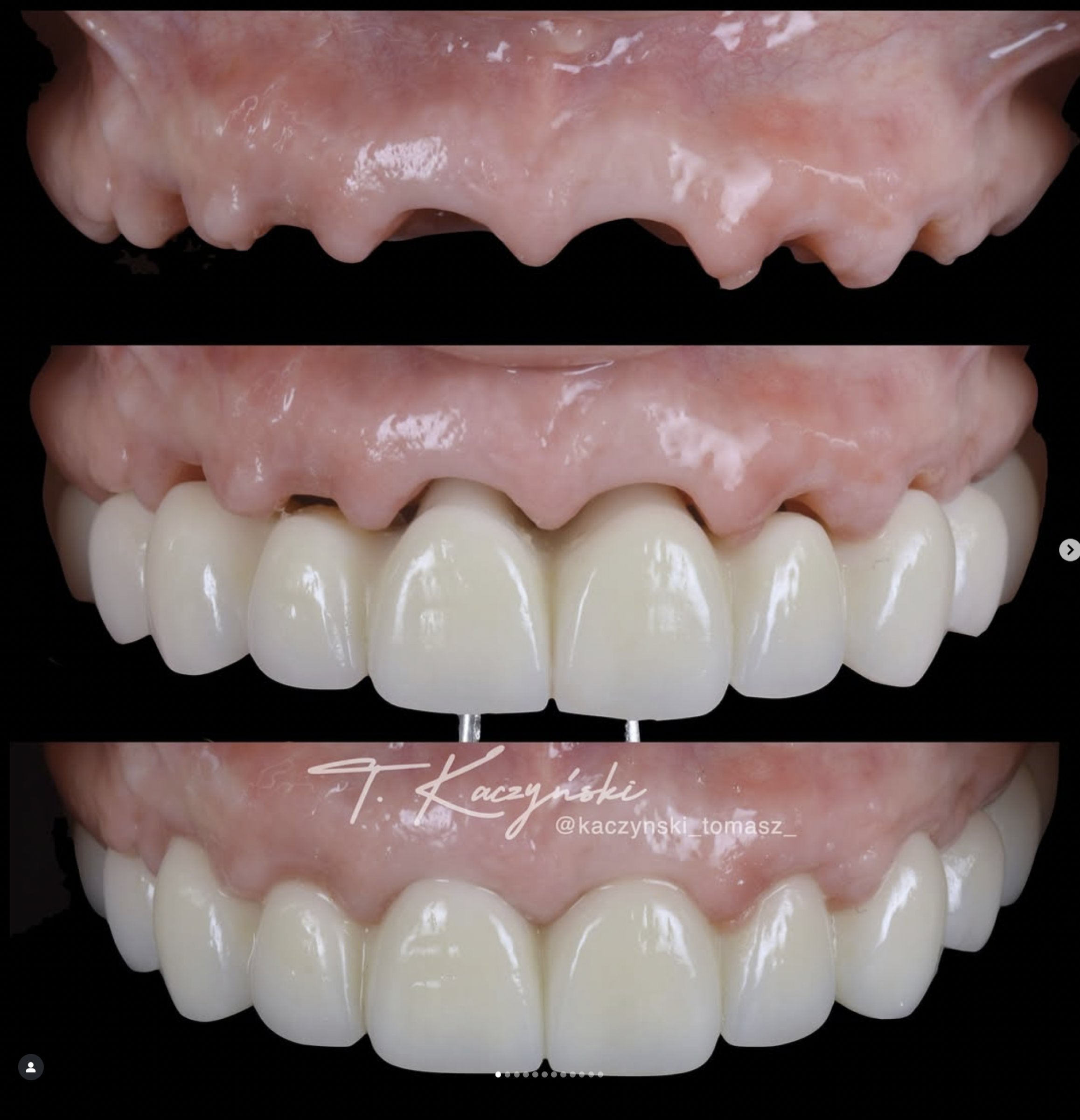
The first few days are a time of natural regeneration, but thanks to the immediately fixed temporary bridge normal functioning is possible almost straight away. The patient does not walk around with gaps or a removable denture – they leave the clinic with a complete, fixed smile.
What happens next with healing
The key process, full integration of the implants with the bone (osseointegration), usually takes three to four months. It runs without symptoms – during that time the patient functions normally on the temporary bridge. After that period the new smile is fully stable and ready for the final prosthetic work.
Do you have a question about your own case?
Every situation is different. During a consultation with a CT scan we will assess precisely which solution will work best for you.
Book a consultation