Zygomatic implants – the solution when there is not enough bone
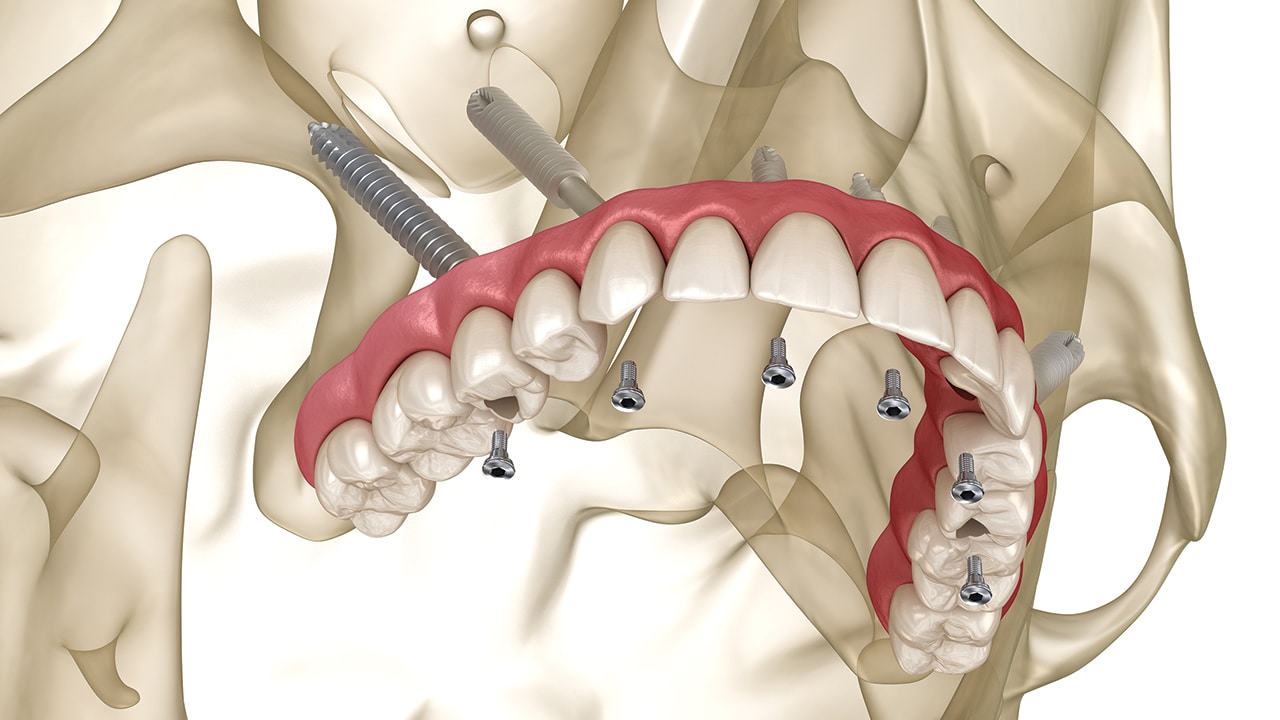
“There is nothing to anchor the implants to” – many patients hear this sentence after years of wearing removable dentures or after unsuccessful attempts at bone reconstruction. In most cases, however, it is not the end of the road. Zygomatic implants were developed for exactly such situations.
What the technique involves
Zygomatic implants are an advanced implantology technique intended for patients with extreme atrophy of the maxillary bone. Instead of in the maxilla, the implants are anchored in the strong zygomatic (cheek) bone – hence the name. This bone does not resorb to the same degree as the alveolar ridge, so it provides stable support even when conventional implantation is impossible.
The most important practical consequence: this technique eliminates the need for extensive bone grafting. That shortens the total rehabilitation time and makes treatment less invasive.
Who they are for
Zygomatic implants are a solution for patients in whom traditional implantation is impossible because of advanced maxillary bone atrophy. This often applies to people who have worn removable dentures for a long time or after unsuccessful bone augmentation attempts.
Main advantages
- No need for bone grafts
- Immediate loading – teeth in one day
- An ideal solution for extreme bone atrophy
- High predictability and durability of treatment
- Shorter total rehabilitation time
How the procedure works
Planning treatment with zygomatic implants is always preceded by detailed imaging diagnostics and analysis of the anatomical conditions. The experience of the surgical team and precise planning of the whole procedure based on digital technologies are of key importance.
The procedure is performed under general anaesthesia or deep sedation. Thanks to precise 3D planning (CBCT) and navigation, it usually takes two to three hours.
The patient receives fixed temporary teeth on the day of the procedure. After a healing period of three to six months the final prosthetic work is made. Zygomatic implants show high success rates in long-term studies.
Why the team's experience matters so much here
This is a demanding procedure, both surgically and in terms of planning. An implant several times longer than a standard one has to be placed along a precisely defined path, avoiding important anatomical structures. That is why few centres in Poland offer it, and why patients are often told beforehand that treatment is not possible – because in that particular practice it really is not.
Do you have a question about your own case?
Every situation is different. During a consultation with a CT scan we will assess precisely which solution will work best for you.
Book a consultation